There are many ways to convey family history. Sometimes we
do it through photos, sometimes through stories, sometimes through beloved
objects, sometimes through traditions—or perhaps, often, a combination of
these. A Different Pond is a quietly masterful picture book in which a father
recalls his childhood fishing on a pond in Vietnam with his father. When this present-day father and his Vietnamese American son fish for the day’s supper before
the work day begins, memories of the war that was fought—and the brother that did
not return—are passed from old to young. These are not easy memories but they
can be key to the awareness of a child finding a place in the span of
generations. Certainly, people moving from one country to another—such as the
refugee family in this book—have a strong reason to share stories, resisting
the possible loss of formative elements of culture and family. As the young boy
in the story hears his father’s memories, he is focused on the details
of helping build a good fire and learning to bait his hook, but
the larger impact of the shared moment is felt. The boy is making his own
memories, yet layers of heritage are conveyed. The expert prose of Bao Phi and the
deeply resonant images of Thi Bui work together seamlessly to relate a story of
struggle, strength, history and family. Endnotes from both author and illustrator
cement our understanding of the sensibilities creators bring to the best of
books. Ages 7 up.
This blog is a continuation of 100 Days, 100 Books, begun on January 20, 2017, highlighting books for young people with themes inherent in a vital democracy: resourcefulness, fairness, justice, courage, creativity and participation. Many are about life in America, historically and in the present. Some are familiar; others may introduce readers to experiences beyond their own. All reflect our rich legacy in literature for young people and the belief that reading opens doors to understanding.
Monday, March 23, 2020
Monday, February 3, 2020
The Watsons Go to Birmingham—1963, by Christopher Paul Curtis
Author
Christopher Paul Curtis has an inimitable way of combining laugh-out-loud humor
with deep and abiding human themes. His first novel, The Watsons Go to
Birmingham—1963, is highly engaging and extraordinarily moving. The Watson
family of Flint, Michigan, heads south to their tiny-but-tough grandmother’s
home in Birmingham, Alabama, to deliver Kenny’s older brother Byron for the
summer, to learn some lessons that his parents hope will keep him from becoming
an “official juvenile delinquent.” Their adventures hold more than they can
begin to imagine. Nine-year-old Kenny narrates his family’s trip; his voice is
full of affection for his momma and dad, little sister Joetta and Byron—and
the fresh anticipation of visiting his mother’s growing-up place. Looking back,
we now know that the summer of 1963 was a pivotal moment in the civil rights
history of our country. Readers might perceive that an ulterior motive of
Kenny’s parents in taking the trip is to introduce their children to the
strains of racism still imbedded in the south, but the deaths of four young
girls in a fire at Sixteenth Street Baptist Church is a horrid shock. Kenny’s
relationship to the blaze and its aftermath are gently told; understandably, it
has a permanent impact on him and on his family. Curtis’s fictional telling of
this historical event, for which he received a Newbery Honor award, is as
graceful as it could possibly be, and a fine introduction to a difficult topic.
Ages 9 -12.
Wednesday, January 1, 2020
Grand Canyon, by Jason Chin
Grand Canyon, written and illustrated by Jason Chin, is an
outstanding multidisciplinary introduction to one of our nation’s most glorious
natural landscapes. Whether or not one has had the chance to visit Grand
Canyon, readers will find Chin’s presentation of the vistas, wildlife and
geologic features of this wonder compelling. In Chin’s book, a father and
daughter explore the depths and details of the canyon, sharing their experience
as they travel. The development of the canyon over millennia is made vivid by
precise depictions of fossils formed and revealed as time passes; a spectacular
counterpoint is presented when facing pages unfold to reveal the canyon's amazing expanse. The necessary care and protection of this treasure will surely
be evident to readers. Chin provides a detailed map and substantial additional
information, inviting even further consideration of this breath-taking
landscape. Ages 7-12.
Friday, December 20, 2019
Ghost Boys, by Jewell Parker Rhodes
In the novel Ghost Boys, author Jewell Parker Rhodes tells the story of twelve-year-old Jerome, who moves daily from the safety of his strong family to the threatening setting of school, where bullies pick on him because he is a truly “good” kid. His family, particularly his Grandma, lives quietly with the fears inherent in being an African American boy in an urban neighborhood. When Jerome’s new friend Carlos (to whom Jerome is nice when Carlos moves up from Texas and has no friends) convinces him to share his toy gun while playing, the worst happens: a local police officer, feeling threatened by the possibility of a gun being turned against him, shoots Jerome. The dispatch with which the white police officer’s case is dismissed is a clear sign of the deep-seated biases of the system of justice with which Jerome and his family live.
In death, Jerome becomes a ghost, able to observe his family’s grief and outrage as he tries to understand what happened to him. His thoughts, in life and in death, are woven into an affecting narrative chapter by chapter. He realizes that, as a ghost, he can be seen and heard by Sarah, the daughter of the officer who killed him. He can also see other ghost boys—those hundreds and hundreds of young men killed, throughout history, by the violence of racism. In particular, Jerome meets Emmett Till, a young black boy killed in an historic incident in 1955, who urges him to tell his story to Sarah. It is the mission of ghost boys to speak their truths to the living, as only the living can help make the world a better place. Sarah grows to understand the systemic nature of her father’s “mistake” and, never alienating her father, she undertakes a school project to explore the conscious and unconscious racism present in society historically and today.
Rhodes’s prose conveys gracefully and authentically the powerlessness Jerome and his family feel faced by fear, loss and grief; the redemptive possibility of learning from history; and the importance of bearing witness to both the pain of racial injustice and the hope for a better future. The difficult themes in Ghost Boys are presented in a stunningly thoughtful, engaging way that invites conversation and understanding. Ages 11 up.
In A Wreath for Emmett Till, author Marilyn Nelson crafts the painful, true story of fourteen-year-old Emmett Till, lynched in 1955 for the alleged crime of whistling at a white woman. Nelson’s fifteen sonnets weave his story in a dignified and searing way and, along with Philippe Lardy’s strong illustrations, invite conversation and is an excellent complement to Ghost Boys. Ages 12 and up.
Wednesday, November 13, 2019
Dreamers, by Yuyi Morales
Readers take a quietly splendid journey with a mother and infant son as they come to the United States from Mexico to make a new life. How strange and difficult it is not to understand the language in this new place, and not to be understood. “One day we bundled gifts in our backpack,” says the mother as they bid goodbye to Corazón, but still their journey as migrantes, as caminantes, is daunting. Then one day, given their own resourcefulness, hopefulness and the welcoming nature of the public library, they discover books. Wonderful books with vibrant pictures and a few words. Picture books that open up their new world in stories. Books become a home where they do not need to feel confident in speaking the new language but where they can grow to understand, to learn, and eventually to speak, write and read in English, bringing all their own gifts as soñadores to the process.
Author and artist Yuyi Morales shares her real life story with readers in an afterword, where we learn that the book Dreamers is based directly on her own experience bringing her young son Kelly to America. Her artwork is a radiant blend of images drawn from her old world and her new world. Her use of the word “dreamers” is not just the same as when applied to undocumented immigrants, common today. Being a dreamer, for her, captures the passions and hopes all immigrants carry with them, no matter what their status, as they navigate the passage to a new land. Morales shares, also, a spectacular list of the books that were special to her and her son as they visited the public library: classic picture books, inventive visual stories, bilingual narratives, poetry, and story collections. This book, also available in a Spanish language edition, brims with possibility for all readers. Ages 4 up.
Monday, October 28, 2019
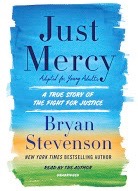
Just Mercy: A True Story of the Fight for Justice, Adapted for Young Adults, by Bryan Stevenson
The 13th Amendment to the Constitution of the United States, ratified in 1865, reads: "Neither slavery nor involuntary servitude, except as a punishment for crime whereof the party shall have been duly convicted, shall exist within the United States, or any place subject to their jurisdiction." While slavery was formally declared ended, history shows us that forced labor and repressive bonds continued to haunt our nation for a century and beyond. Today still, the criminal justice system affects poor and black people disproportionately. As a young law student in 1983, Bryan Stevenson took an internship in Georgia, experiencing death row through the eyes of a man facing execution. As he came to understand the realities of detention and how often marginalized individuals – young people in particular -- were swept into an unrelenting process of incarceration, Stevenson focused his efforts on representing those wrongfully imprisoned. He advocated prohibiting sentencing children less than 18 years of age to death or to life in prison without parole, winning landmark cases before the U. S. Supreme Court. Stevenson’s Just Mercy: A True Story of the Fight for Justice and Mercy, Adapted for Young Adults, describes the struggles he faced, as a lawyer and a compassionate person, while defending prisoners who were clearly disadvantaged within a confusing and sometimes duplicitous system. The narrative traces the cases of several people, such as the unjustly convicted Walter McMillian, from Stevenson’s initial encounter to their resolutions. In the process, readers travel the pathways of arrest, detention, conviction and appeals; local, state and regional law enforcement practices; prison life and parole; and the impact on families and communities when cases can take years and years to be addressed adequately. Stevenson conveys, directly yet with respectful tenderness, the values of justice and equity that reside at the heart of a democratic society. Believing that “all of us can do better for one another,” Stevenson founded in Montgomery, Alabama, the Equal Justice Initiative and, in recent years, The Legacy Museum: From Enslavement to Mass Incarceration, displaying the history of slavery and racism in the United States, and the National Memorial for Peace and Justice, honoring the names of the thousands of victims of lynching between 1877 and 1950. Ages 12 and up.
Subscribe to:
Posts (Atom)