Tuesday, February 22, 2022

How to Build a Museum: Smithsonian's National Museum of African American History and Culture, by Tonya Bolden


On February 22, 2012, the ground was broken for a very special place: the Smithsonian’s National Museum of African American History and Culture. The chapters of author Tonya Bolden’s remarkable book guide readers seamlessly through the complex elements of building a museum from scratch: articulating its mission, seeking location and design ideas, gathering exhibit materials from everyday sources as well as famous people and notable events, and maintaining a welcoming venue, all while holding foremost its educational and inspirational value for all audiences. Bolden introduces the key people behind the museum—its Director Lonnie Bunch and countless others (architects, construction workers, curators, contributors and so many more) who made the museum a reality. Bolden’s text is highlighted throughout by dozens of well-chosen photos and artifacts, resulting in a truly fascinating saga.


The NMAAHC opened for visitors on September 24, 2016, but it had been a vision in the eyes of many people decades earlier. The idea to honor “the Negro Soldiers and Sailors who fought in the Wars of Our Country” was hatched when Civil War veterans met for a commemorative encampment in 1915, in Washington, DC. Over the following years, various African American leaders contributed to the public and legislative vision; the concept experienced ups and downs but the dream continued. Where in our capital city might such a wonderful museum be placed? How would it be funded? What would it contain and how would people learn about it? Finally, in 1988, Representative John Lewis of Georgia introduced a bill for a national museum that would be included among the Smithsonian’s remarkable array of museums. By 2003 a final bill was passed by Congress, a commission created, and a plan of action written. The plan was comprehensive, built upon the idea that African American history and culture can be a lens through which to consider what being an American means; that bringing together materials from all walks of life in the African American experience is valuable; that collaboration with a range of museums and educational settings works; and that welcoming all visitors is paramount. 


As Tonya Bolden says in her preface: a museum’s aim is “to safeguard remnants of history and culture that inspire, enlighten, and kindle the curiosity of the children and adults who come through its doors, generation after generation.” This book is the perfect way to understand a museum from conception to reality, and a perfect way to anticipate visiting the rich collection of the Smithsonian's National African American Museum of History and Culture! Ages 9 and up. Viking Books for Young Readers, 2016.


Another book readers may enjoy along with Bolden’s book is Sing a Song: How ‘Lift Every Voice and Sing’ Inspired Generations, by Kelly Starling Lyons and illustrated by Keith Mallett. On September 24, 2016, this song was sung at the opening of the National Museum of African American History and Culture. Known to many as the Black national anthem, “Lift Every Voice and Sing” is a richly inspiring song of hope sung by communities far and wide since penned by James Weldon Johnson in 1900 as part of his students’ celebration of Abraham Lincoln’s birthday. Lyons’s book captures beautifully how the song has been passed along from parent to child, how it has been an enduring source of strength for individuals, communities and choruses over many years and remains so today. Ages 5-8. Nancy Paulsen Books, 2019.


https://nmaahc.si.edu/highlights-our-dedication-ceremony


Monday, January 17, 2022

Light for All, by Margarita Engle, illustrated by Raul Colón


How is it possible for very young people to understand immigration—what it means to come to the United States from another land? In Light for All, author Margarita Engle tells that story in few but very well-chosen words. Illustrator Raul Colón depicts, warmly and empathetically, each element of the narrative in the faces and body language of the mothers, father, brothers and sisters who enter a new country by the light of the Statue of Liberty. People come to rejoin family; to leave behind hunger and war and natural disasters; to seek livelihoods that use their skills; to make a new life in a new land. It is not always easy to be a newcomer, but exercising the freedom to express oneself can help. Maybe learning a new language doesn’t mean leaving behind one’s first land or language but adding them to the mix here already—adding to the stories of the people who were earlier immigrants, or whose native land was invaded, or who were brought as enslaved people. Engle’s text does not spare the difficult parts of our history but casts a positive light on possibility as represented in the Statue of Liberty’s promise—the opportunity for us to understand and truly welcome people new to our land, to celebrate our freedoms and hope for equality. In an Author’s Note and an Illustrator’s Note, readers learn more about why Engle and Colón chose to create this book, which is a fine introduction—an excellent conversation-starter—to the generations of people who comprise our diverse and vibrant nation. Ages 4-8. Simon & Schuster Books for Young Readers, 2021.

Tuesday, December 14, 2021

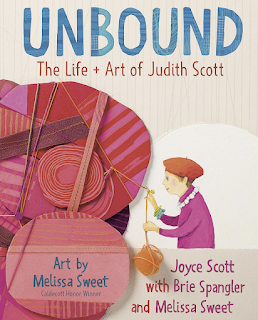
Unbound: The Life and Art of Judith Scott, by Joyce Scott and Brie Spangler, with art by Melissa Sweet


In Unbound: The Life & Art of Judith Scott, readers follow the remarkable journey of a person born a twin and born with Down syndrome, a genetic condition when a person's DNA carries an extra chromosome. Judith’s parents and twin sister Joyce welcome her into their loving family, and the sisters play together as “two peas in a pod.” But when Joyce enters kindergarten, Judy is not admitted because of her special needs; in 1948, Down syndrome had not yet been named as a genetic condition and some of its characteristics and impact on individuals were not known. Judy’s parents must place her in an institution for people with disabilities—many of which were not well understood—and for years Joyce remains heartbroken that her sister lives in a grey, dispirited place, without the kinds of resources and stimulation that most people have at hand. When preparing to move to California with her family, Joyce works to become Judy’s legal guardian so she can join them in their new home. Soon, they discover the Creative Growth Art Center in Oakland, CA, and Judy enters a colorful, affirming environment where adults with disabilities are encouraged to explore and express their individual creative energies. Months pass before Judy reaches out and joins the busy artists at work, but once she takes hold of natural materials, yarn and twine she begins her own expressive journey—a journey that lasts the rest of her life. With the support of her teachers and increasing recognition of the expressive potential of people with developmental differences, Judy thrives. From her mid-40s until her death in 2005, Judy creates glorious sculptures with fibers and found objects; museums around the world feature her work. Joyce Scott and Brie Spangler’s flawless narrative introduces readers to Judy's latent spirit, the positivity of her twin, and the joyous emergence of an artist’s drive to create. Melissa Sweet’s illustrations are the perfect accompaniment, capturing the layered dimensions of Judy’s life journey—ultimately bursting forth with the color, textures and vibrancy of Judy’s remarkable creations. Endnotes about Down syndrome, a timeline that includes both Judy’s life events and key Federal acts providing support and equal opportunities for people with disabilities, and author and illustrator notes convey how urgently the story of disability and creativity needs to be told. Ages 4-9. Alfred A. Knopf/Random House Children’s Books, 2021


Here is more information about Down syndrome and the landmark school where Judy discovered her artistry: 

https://www.ds-int.org and https://creativegrowth.org


Wednesday, November 24, 2021

We Are Grateful * Otsaliheliga and We Are Still Here: Native American Truths Everyone Should Know, by Traci Sorell, illustrated by Frané Lessac


Author Traci Sorell, a citizen of the Cherokee Nation, has given readers two gifts: her picture books We Are Grateful * Otsaliheliga and We Are Still Here: Native American Truths Everyone Should Know. Both are rich with information about the history and customs of Native Americans. Frané Lessac’s colorful illustrations – bold and detailed -- provide a perfect complement to the text.  

In We Are Grateful * Otsaliheliga, readers are invited to travel through the year and consider the reasons to celebrate what each season—indeed, each day—brings. The cool breezes of fall and the Great New Moon Ceremony. The stories and memories shared at wintertime, around a table with good food. In spring, the waters flowing, sprouts emerging and strawberries blossoming. Summer brings burgeoning fields, creeks full of crawdads, and then the Green Corn Ceremony honoring the first harvest. Woven into the graceful narrative are glimpses of both traditional and contemporary activities of family and community: fathers tending babies, young people learning to sew moccasins and build clay pots, students understanding traditions of the Cherokee people. Importantly, readers become familiar with the word otsaliheilga, meaning “We are grateful.” Gratitude—for all that life provides both good and difficult—is central to honoring the past and the present. Indeed, readers meet many words of the Cherokee language and are encouraged to pronounce them; they are presented phonetically, in English and in the Cherokee alphabet. Appended are further descriptions of concepts and holidays, an author’s note, an introduction to the Cherokee syllabary and a link to further information about the Cherokee Nation at www.cherokee.org. Ages 4-8.  Charlesbridge (HC), 2018 ; Scholastic (PB), 2019.


A comprehensive look at the history of Native Nations is presented by Sorell and Lessac in their non-fiction, richly-illustrated picture book We Are Still Here: Native American Truths Everyone Should Know. The setting is the Native Nations Community School, where twelve student presentations for Indigenous Peoples’ Day introduce readers to elemental aspects of Native history. Projects recount how life changed for Indigenous peoples when white people arrived from Europe and how the sovereignty of Native Nations has been both honored and deeply challenged through the centuries. Treaties between Native peoples and the U. S. government were made and broken; laws and practices tried variously to preserve or diminish Native cultures and languages; communities sometimes received support but often needs were ignored or misunderstood. Throughout the story, the refrain “We are still here” speaks to the endurance of Native peoples over many years. The specific student presentations highlight Assimilation, Allotment, the Indian New Deal, Termination, Relocation, Tribal Activism, Self-Determination, Indian Child Welfare and Education, Religious Freedom, Economic Development, Language Revival, and Sovereign Resurgence. Seen through the eyes of young people, topics are explained lucidly, providing a substantive opportunity for both Native and non-Native readers to know more about Indigenous peoples' history. A thorough time line, a glossary of terms and an author’s note further enrich this excellent book. Ages 8 and up. Charlesbridge, 2021.

Monday, October 18, 2021

Dr. Fauci: How a Boy from Brooklyn Became America's Doctor, by Kate Messner, illustrated by Alexandra Bye


Anthony Fauci was a lucky child. He was a naturally curious kid, and he had warm and supportive parents. His father, particularly, supported him in exploring the solution to a problem—whether it was homework, chatting with the tough guys in his neighborhood or countering his short stature by being quick on his feet during basketball. Anthony’s interest in being a doctor bloomed in high school and carried him through medical school; ultimately, he became an expert in infectious diseases. The curiosity Fauci had as a child served him well: he kept an open mind as he explored evidence and searched for solutions for new diseases such as AIDS and SARS. At the National Institute of Allergy and Infectious Diseases, he worked as a health advisor under seven U. S. presidents.


In DR. FAUCI: How a Boy from Brooklyn Became America’s Doctor, written by Kate Messner and illustrated by Alexandra Bye, readers are invited to share in Dr. Fauci’s curiosity and confidence as he met new challenges. One of his biggest challenges has been confronting the fast-spreading coronavirus COVID-19, which swept across our nation and the globe. Supported by a network of scientists around the world, health experts highlighted important ways for individuals and communities to stay safe while vaccines were being developed. This excellent, colorfully illustrated narrative biography is extended with an explanation of how vaccines work, wonderful photos of the Fauci family, Dr. Fauci’s five tips for future scientists, and intriguing recommendations for further reading about problem-solving scientists. Perfect for young people ages 4-8, this book is informative and inspiring for people of all ages! Simon & Schuster Books for Young Readers, 2021.


Readers can learn more about the National Institutes of Health here.


Friday, September 24, 2021

The People's Painter: How Ben Shahn Fought for Justice with Art, by Cynthia Levinson, with pictures by Evan Turk


In The People’s Painter: How Ben Shahn Fought for Justice with Art, readers take a fascinating journey through the life of an artist driven to create images of real lives and real places around him. As a young child in Lithuania, Ben Shahn noticed things: how his elders created useful objects out of wood and clay, how elegant the letters of his Hebrew Bible stories were. He also saw, and felt, the injustices around him: students or teachers at school bullying or discrediting him, his father taken away from the family for speaking against the Czar. Ben put his thoughts and feelings into pictures—a passion that would drive his energy for the rest of his life. Eventually Ben’s father escaped to America, and the family was able to follow when Ben was eight years old. Ben captured the life around him in America—chalking sidewalk portraits of boys who teased him, copying the forms of English text in his schoolbooks. Soon Ben had to leave school to help support his family and, working for a lithographer, he learned techniques of lettering and carving. At night he attended art school but his instructors did not appreciate his work based on real life, telling him to paint beautiful scenes instead. But Ben was compelled to convey the injustices he saw around him. His realistic images portrayed powerfully the lives of working people, poor people, immigrants and prisoners. He took photographs and painted murals as part of President Roosevelt’s New Deal programs to assist people suffering in the Great Depression. In the 1930s, he created a series of paintings about Nicola Sacco and Bartolomeo Vanzetti, two immigrant men who spoke out against the government, and were convicted of murder in a trial which many people felt was unjust. Ben’s unrelentingly realistic art—in scenes that did not portray a beautiful America—led to accusations by the Federal Bureau of Investigation that Ben was disloyal. Overcoming these threats, Ben continued to paint as a social activist in support of peace and justice. His work stands as an enduring record of decades of our history. 


To conclude this wonderful picture book biography, Cynthia Levinson presents an Author’s Note placing the life of Ben Shahn in historical context, sharing her long appreciation of the themes in his art, and providing windows to her scholarly research. In an Illustrator’s Note, Evan Turk tells readers that Shahn’s work has always been his inspiration–in their bold, expressive energy and storytelling power. Levinson’s narrative and Turk’s colorful pages together convey one artist’s drive to capture the complex world around him. Ages 5-9. Abrams Books for Young Readers, 2021.

Friday, August 27, 2021

The Highest Tribute: Thurgood Marshall’s Life, Leadership, and Legacy, by Kekla Magoon, illustrated by Laura Freeman


Thurgood Marshall grew up at a time when there were many “Whites Only” signs on businesses and public places in his home city of Baltimore, Maryland. His parents encouraged conversations around the dinner table discussing concerns about what was fair and what was not. When reading the U. S. Constitution (his teacher required him to do so after he acted out in class), Thurgood began to wonder how—when our nation’s laws declared all persons equal—huge disparities in treatment could exist. He loved discussing and debating. He practiced using his curiosity, analytical mind and strong voice all during high school and college and into law school. Over time, Thurgood Marshall became an important part of many “firsts” in matters of racial equality. He participated in the first interracial debate between U.S. colleges in 1928; as a lawyer he won a case establishing the first court order to desegregate a school in 1935; in 1954 he won the landmark U. S. Supreme Court case Brown vs. Board of Education making all school desegregation unconstitutional. After years of hard and determined work for the National Association for the Advancement of Colored People (NAACP) and then as Solicitor General (the first Black person in this position, arguing cases before the Supreme Court), he was sworn in as a Supreme Court Justice in 1967, serving until 1991. Marshall was known as an “activist” judge, who consistently set the bar high on issues of fairness and equality under the law. In the picture book biography The Highest Tribute: Thurgood Marshall’s Life, Leadership, and Legacy, author Kekla Magoon weaves the details of Marshall’s barrier-breaking career into a fully engaging narrative. Laura Freeman’s vivid, sensitive illustrations bring wonderful immediacy to Marshall’s strong character. This inspiring book ends with a timeline of Marshall’s life and descriptions of major court cases. Ages 5-10. Quill Tree Books / HarperCollins Publishers, 2021.

For a contemporary look at Thurgood Marshall’s legacy, view the website of the Legal Defense Fund’s Thurgood Marshall Institute: https://tminstituteldf.org