Sunday, May 15, 2022

Front Desk, by Kelly Yang & Watercress, by Andrea Wang, illustrated by Jason Chin


Mia and her mom and dad dream of a new future when they come to the United States from China. But when they finally secure jobs as the caretakers of a motel, life is not what they hoped. The motel’s owner, Mr. Yao, does not keep his promises about anything, making it extremely difficult for Mia and her family to keep themselves or the motel going. Mia’s contribution to the family effort is working the front desk while her parents clean. Her indomitable spirit gives her the energy to identify not only ways to improve the motel but to reach out to people who seem to have it even harder than they do. She cultivates her new skills in English by writing letters advocating to correct injustices she observes, and she even enters a writing contest to win a motel of her own so they will no longer need to tolerate Mr. Yao. In the chapter book Front Desk, author Kelly Yang perfectly captures the voices of Mia, her parents, and the friendly long-term motel residents. Memorable moments pepper the story, and readers will celebrate Mia’s spirited actions as she tries and tries again to bring an even playing field to the Calivista Motel. Set in 1990s California, Front Desk does not shy away from difficult themes in immigration, poverty and prejudice, yet the narrative is graced with humor. Mia’s indomitable spirit, as she both succeeds and stumbles, provides bridges to understanding and empathy, resulting in an excellent story for middle grade readers. Ages 8-12. Alfred A. Levine Books / Scholastic, 2018.


Rendered with both delicacy and strength, the picture book Watercress depicts the experience of a young girl as she struggles to engage in harvesting the stringy, green watercress spotted by the side of the road by her parents. She refuses to eat it, even when it is prepared with garlic and sesame seeds by her China-born parents. But soon her parents are sharing stories from their childhood—memories both hard and happy, with harvesting watercress among them. Author Andrea Wang bases her gentle narrative on her own experience growing up in the Midwest as a child of Chinese immigrants. In an author’s note, she encourages adults to share stories of their growing-up times, an important part of family heritage no matter what that history is. Illustrator Jason Chin states in an artist’s note how he sought to convey the many-layered aspects of the story in his sensitive watercolors, for which he received the Caldecott Medal. Ages- 4-8. Neal Porter Books / Holiday House, 2021. 


For ideas about other good books:

https://www.zinnedproject.org/materials/asian-americans-and-moments-in-peoples-history/

Friday, April 22, 2022

Spring After Spring: How Rachel Carson Inspired the Environmental Movement, by Stephanie Roth Sisson


The Japanese poet Matsuo Bashó wrote: “Sitting quietly, doing nothing,  Spring comes, and the grass grows, by itself.”

Nature’s eternal clock—day to day and season to season—entranced Rachel Carson as a child. She loved spending time outdoors exploring. She listened to the chorus of birdsongs around her in the morning… “Chee-chee…caw, caw!...whoo whoo…” She had the comfort of her family at night and was ready to go exploring the next day. Rachel thought she would grow up to be a writer and tell all about what she saw and heard. Then in college, she studied the tiny forms of life she could see through a microscope, and became a scientist. She studied the plants and animals of the ocean in particular, and wrote wonderful books read by many people. But then Rachel noticed something important about the birdsongs that she so loved: they were disappearing. Exploring further, studying carefully, she realized that the chemicals people were using to protect themselves and plants from insect pests were harmful chemicals that destroyed birds and other creatures important to nature’s cycle of life. Her book Silent Spring  informed the public about the poisons being used in the environment; the U. S. Congress also listened to her authoritative testimony, and laws protecting nature began to be passed. The picture book biography Spring After Spring: How Rachel Carson Inspired the Environmental Movement is the story of a fascinating woman. Stephanie Roth Sisson says in her Author’s Note: “Silent Spring is one of those books that changes the way a whole society thinks.” Indeed, Rachel Carson’s work can be considered the keystone of the modern environmental movement. Sisson's graceful words and delightful pictures weave together to provide lasting inspiration to readers to continue Carson’s attention to nature’s eternal clock--and to consider our own roles in protecting our delicate ecosystem. Roaring Brook Press, 2018. Ages 4-8.

Tuesday, March 22, 2022

Sanctuary: Kip Tiernan and Rosie’s Place, the Nation’s First Shelter for Women, by Christine McDonnell, illustrated by Victoria Tentler-Krylov


Often, the names of people who have done notable things become household words; we know about them and their accomplishments. Sometimes we discover the name and the accomplishments of someone we didn’t know about. Sanctuary: Kip Tiernan and Rosie’s Place, the Nation’s First Shelter for Women introduces readers to just such a person. Author Christine McDonnell’s engaging biography of Kip Tiernan shares the scope of a determined, principled woman’s life – from standing at her generous grandmother’s side as she fed hungry people from her own kitchen during the Great Depression of the 1930s, through Tiernan’s response to the call for change to help end poverty and war in the 1960s, to her realization that women were an unidentified part of the homeless population. After listening to and observing the visitors to Saint Joseph’s House of Hospitality in New York City, open to all those struggling for sustenance and support, Kiernan returned to Boston determined to find a place where women could come to be safe, warm and fed. After much advocacy, the city of Boston rented her an empty supermarket space, which opened as Rosie’s Place on Easter Sunday in 1974. First, there were coffee and sandwiches offered, and then hot meals and beds. Soliciting support from people who could contribute money to Rosie’s Place, Tiernan boldly stated: “Who decides who gets the condo and who gets the cardboard box?” An activist through and through, she also lent her energies to Boston Health Care for the Poor, the Greater Boston Food Bank, the Poor People’s United Fund and the push for permanent housing for the unsheltered. Victoria Tentler-Krylov’s paintings warmly convey the needs of underserved individuals and the dignity with which they can be given a space to rest and move forward. In a post-script “More about Kip Tiernan” readers learn about causes of homelessness and the memorial to Tiernan near Copley Square in Boston. Just think about all the people whose names are not “household words” but whose lives have exemplified the very best instincts and service to society! Do you know someone like that about whom you can tell a story? Ages 7-10. Candlewick Press, 2022.

Tuesday, February 22, 2022

How to Build a Museum: Smithsonian's National Museum of African American History and Culture, by Tonya Bolden


On February 22, 2012, the ground was broken for a very special place: the Smithsonian’s National Museum of African American History and Culture. The chapters of author Tonya Bolden’s remarkable book guide readers seamlessly through the complex elements of building a museum from scratch: articulating its mission, seeking location and design ideas, gathering exhibit materials from everyday sources as well as famous people and notable events, and maintaining a welcoming venue, all while holding foremost its educational and inspirational value for all audiences. Bolden introduces the key people behind the museum—its Director Lonnie Bunch and countless others (architects, construction workers, curators, contributors and so many more) who made the museum a reality. Bolden’s text is highlighted throughout by dozens of well-chosen photos and artifacts, resulting in a truly fascinating saga.


The NMAAHC opened for visitors on September 24, 2016, but it had been a vision in the eyes of many people decades earlier. The idea to honor “the Negro Soldiers and Sailors who fought in the Wars of Our Country” was hatched when Civil War veterans met for a commemorative encampment in 1915, in Washington, DC. Over the following years, various African American leaders contributed to the public and legislative vision; the concept experienced ups and downs but the dream continued. Where in our capital city might such a wonderful museum be placed? How would it be funded? What would it contain and how would people learn about it? Finally, in 1988, Representative John Lewis of Georgia introduced a bill for a national museum that would be included among the Smithsonian’s remarkable array of museums. By 2003 a final bill was passed by Congress, a commission created, and a plan of action written. The plan was comprehensive, built upon the idea that African American history and culture can be a lens through which to consider what being an American means; that bringing together materials from all walks of life in the African American experience is valuable; that collaboration with a range of museums and educational settings works; and that welcoming all visitors is paramount. 


As Tonya Bolden says in her preface: a museum’s aim is “to safeguard remnants of history and culture that inspire, enlighten, and kindle the curiosity of the children and adults who come through its doors, generation after generation.” This book is the perfect way to understand a museum from conception to reality, and a perfect way to anticipate visiting the rich collection of the Smithsonian's National African American Museum of History and Culture! Ages 9 and up. Viking Books for Young Readers, 2016.


Another book readers may enjoy along with Bolden’s book is Sing a Song: How ‘Lift Every Voice and Sing’ Inspired Generations, by Kelly Starling Lyons and illustrated by Keith Mallett. On September 24, 2016, this song was sung at the opening of the National Museum of African American History and Culture. Known to many as the Black national anthem, “Lift Every Voice and Sing” is a richly inspiring song of hope sung by communities far and wide since penned by James Weldon Johnson in 1900 as part of his students’ celebration of Abraham Lincoln’s birthday. Lyons’s book captures beautifully how the song has been passed along from parent to child, how it has been an enduring source of strength for individuals, communities and choruses over many years and remains so today. Ages 5-8. Nancy Paulsen Books, 2019.


https://nmaahc.si.edu/highlights-our-dedication-ceremony


Monday, January 17, 2022

Light for All, by Margarita Engle, illustrated by Raul Colón


How is it possible for very young people to understand immigration—what it means to come to the United States from another land? In Light for All, author Margarita Engle tells that story in few but very well-chosen words. Illustrator Raul Colón depicts, warmly and empathetically, each element of the narrative in the faces and body language of the mothers, father, brothers and sisters who enter a new country by the light of the Statue of Liberty. People come to rejoin family; to leave behind hunger and war and natural disasters; to seek livelihoods that use their skills; to make a new life in a new land. It is not always easy to be a newcomer, but exercising the freedom to express oneself can help. Maybe learning a new language doesn’t mean leaving behind one’s first land or language but adding them to the mix here already—adding to the stories of the people who were earlier immigrants, or whose native land was invaded, or who were brought as enslaved people. Engle’s text does not spare the difficult parts of our history but casts a positive light on possibility as represented in the Statue of Liberty’s promise—the opportunity for us to understand and truly welcome people new to our land, to celebrate our freedoms and hope for equality. In an Author’s Note and an Illustrator’s Note, readers learn more about why Engle and Colón chose to create this book, which is a fine introduction—an excellent conversation-starter—to the generations of people who comprise our diverse and vibrant nation. Ages 4-8. Simon & Schuster Books for Young Readers, 2021.

Tuesday, December 14, 2021

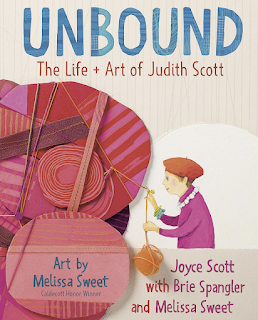
Unbound: The Life and Art of Judith Scott, by Joyce Scott and Brie Spangler, with art by Melissa Sweet


In Unbound: The Life & Art of Judith Scott, readers follow the remarkable journey of a person born a twin and born with Down syndrome, a genetic condition when a person's DNA carries an extra chromosome. Judith’s parents and twin sister Joyce welcome her into their loving family, and the sisters play together as “two peas in a pod.” But when Joyce enters kindergarten, Judy is not admitted because of her special needs; in 1948, Down syndrome had not yet been named as a genetic condition and some of its characteristics and impact on individuals were not known. Judy’s parents must place her in an institution for people with disabilities—many of which were not well understood—and for years Joyce remains heartbroken that her sister lives in a grey, dispirited place, without the kinds of resources and stimulation that most people have at hand. When preparing to move to California with her family, Joyce works to become Judy’s legal guardian so she can join them in their new home. Soon, they discover the Creative Growth Art Center in Oakland, CA, and Judy enters a colorful, affirming environment where adults with disabilities are encouraged to explore and express their individual creative energies. Months pass before Judy reaches out and joins the busy artists at work, but once she takes hold of natural materials, yarn and twine she begins her own expressive journey—a journey that lasts the rest of her life. With the support of her teachers and increasing recognition of the expressive potential of people with developmental differences, Judy thrives. From her mid-40s until her death in 2005, Judy creates glorious sculptures with fibers and found objects; museums around the world feature her work. Joyce Scott and Brie Spangler’s flawless narrative introduces readers to Judy's latent spirit, the positivity of her twin, and the joyous emergence of an artist’s drive to create. Melissa Sweet’s illustrations are the perfect accompaniment, capturing the layered dimensions of Judy’s life journey—ultimately bursting forth with the color, textures and vibrancy of Judy’s remarkable creations. Endnotes about Down syndrome, a timeline that includes both Judy’s life events and key Federal acts providing support and equal opportunities for people with disabilities, and author and illustrator notes convey how urgently the story of disability and creativity needs to be told. Ages 4-9. Alfred A. Knopf/Random House Children’s Books, 2021


Here is more information about Down syndrome and the landmark school where Judy discovered her artistry: 

https://www.ds-int.org and https://creativegrowth.org


Wednesday, November 24, 2021

We Are Grateful * Otsaliheliga and We Are Still Here: Native American Truths Everyone Should Know, by Traci Sorell, illustrated by Frané Lessac


Author Traci Sorell, a citizen of the Cherokee Nation, has given readers two gifts: her picture books We Are Grateful * Otsaliheliga and We Are Still Here: Native American Truths Everyone Should Know. Both are rich with information about the history and customs of Native Americans. Frané Lessac’s colorful illustrations – bold and detailed -- provide a perfect complement to the text.  

In We Are Grateful * Otsaliheliga, readers are invited to travel through the year and consider the reasons to celebrate what each season—indeed, each day—brings. The cool breezes of fall and the Great New Moon Ceremony. The stories and memories shared at wintertime, around a table with good food. In spring, the waters flowing, sprouts emerging and strawberries blossoming. Summer brings burgeoning fields, creeks full of crawdads, and then the Green Corn Ceremony honoring the first harvest. Woven into the graceful narrative are glimpses of both traditional and contemporary activities of family and community: fathers tending babies, young people learning to sew moccasins and build clay pots, students understanding traditions of the Cherokee people. Importantly, readers become familiar with the word otsaliheilga, meaning “We are grateful.” Gratitude—for all that life provides both good and difficult—is central to honoring the past and the present. Indeed, readers meet many words of the Cherokee language and are encouraged to pronounce them; they are presented phonetically, in English and in the Cherokee alphabet. Appended are further descriptions of concepts and holidays, an author’s note, an introduction to the Cherokee syllabary and a link to further information about the Cherokee Nation at www.cherokee.org. Ages 4-8.  Charlesbridge (HC), 2018 ; Scholastic (PB), 2019.


A comprehensive look at the history of Native Nations is presented by Sorell and Lessac in their non-fiction, richly-illustrated picture book We Are Still Here: Native American Truths Everyone Should Know. The setting is the Native Nations Community School, where twelve student presentations for Indigenous Peoples’ Day introduce readers to elemental aspects of Native history. Projects recount how life changed for Indigenous peoples when white people arrived from Europe and how the sovereignty of Native Nations has been both honored and deeply challenged through the centuries. Treaties between Native peoples and the U. S. government were made and broken; laws and practices tried variously to preserve or diminish Native cultures and languages; communities sometimes received support but often needs were ignored or misunderstood. Throughout the story, the refrain “We are still here” speaks to the endurance of Native peoples over many years. The specific student presentations highlight Assimilation, Allotment, the Indian New Deal, Termination, Relocation, Tribal Activism, Self-Determination, Indian Child Welfare and Education, Religious Freedom, Economic Development, Language Revival, and Sovereign Resurgence. Seen through the eyes of young people, topics are explained lucidly, providing a substantive opportunity for both Native and non-Native readers to know more about Indigenous peoples' history. A thorough time line, a glossary of terms and an author’s note further enrich this excellent book. Ages 8 and up. Charlesbridge, 2021.